When you think of acupuncture, what´s the first thing that comes to mind?
For me, it was those posters outside acupuncture clinics claiming it could cure everything. And I remember thinking: “That can´t be right – if it were, we wouldn´t have any diseases!”
And you know what? That´s true. Acupuncture insn´t some magical cure-all, but rather an ingredient in a healthy lifestyle, just like diet, exercise, and mental well-being.
So, what does acupuncture do? Does it actually work?
The answer is: yes… and no – at least, not in the way that Western medicine works.
Acupuncture can help with a range of physical and emotional symptoms, and we now have scientificproof to back it up, alongside centuries of successful cases.
To understand how it works, we need to stop thinking of the body as separate parts and instead see it as one connected system. Your genetics, emotions, and even how your body responds to the weather – it´s all linked!
This is because we have a highway of nerves and fascia connecting every organ to the skin.
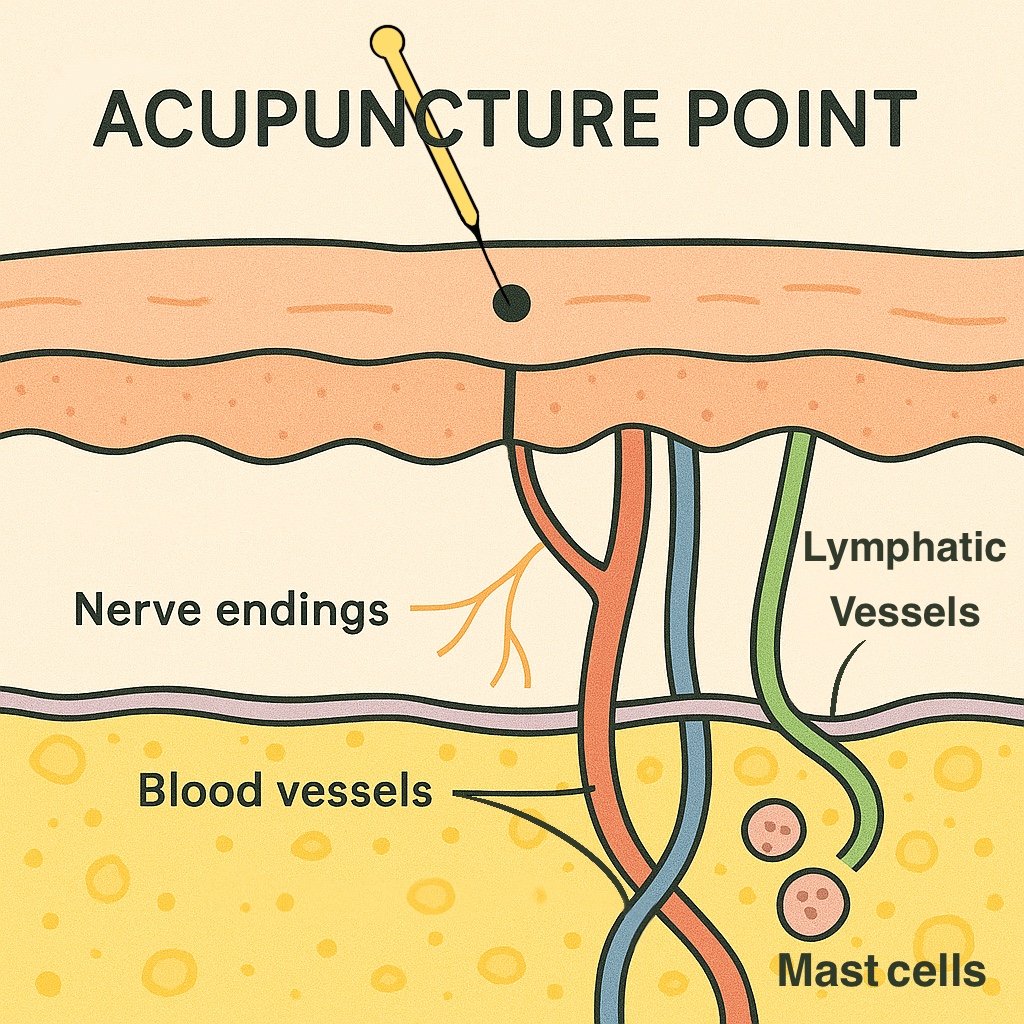
Each Acupuncture point is a special location in the body where we find:
Nerve Ending
Blood Vessels
Lorem ipsum dolor sit amet, consectetur adipiscing elit.
Lymphatic Vessels
Lorem ipsum dolor sit amet, consectetur adipiscing elit.
Fascia Tissue
Lorem ipsum dolor sit amet, consectetur adipiscing elit.
Mast Cells
Lorem ipsum dolor sit amet, consectetur adipiscing elit.
When the needle is inserted, it triggers a chain reaction in the body, realeasing a cocktail of "happy chemicals" including:
Endorphins
Natural painkillers that promote relaxation and happines
Serotonin
Hormone that controls your mood
Norepinephrine
Helps regulate stress and improve focus
GABA
(Gamma-aminobutyric)
Reduces anxiety and calms the nervous system
Dopamine
Gives feeling of pleasure, satisfaction and motivation. Also controls movement.
Oxytocin
The “love hormone” that fosters emotional bonding and well-being.
But that´s not all, these chemicals don´t just block pain and help you relax – they also stimulate brain remodeling!
That means acupunture doesn´t just treat symptoms, it helps your brain and nervous system adapt, heal and function better over time.
If all sounds like Chinese to you (pun intended), don´t worry! I will explain everything from the beginning in another post.
References
1.BASBAUM, A. I., FIELDS, H. L. 1984. Endogenuos pain control systems: brainstem pinal pathways and endorphin circuitry. An. Rev Neurosci; 7: 309-338. 2. BOSSY, J. 1973. Bases morfologiques et fonctionelles de l´analgésie acupuncturale. Giorn.Accad. Med. Torino., 12: 223 245. 3. BECKER, R. O., RECHMAINS, M. 1976. Electrophysiological correlates of acupuncture points and meridians. Pychoenergetic Sytems, 1: 195-212. 4. CHAN, S. H. H., FUNG, S. J. 1975. Suppression of polysynaptic reflex by electro-acupuncture and a possible underlying presynaptic mechanism in the spinal cord of the cat. Exp Neurol; 48:336-334 5. CHANN, S. H. H. 1984. What is being stimulated in acupuncture. Evaluation od existence of a specific substrate. Neurosci Biobehav; 8: 25-33. 6. CHENG, R., POMERANZ, B. 1980. Electroacupunture analgesia could be mediated by at least two pain-relieving mechanism: endophirn and non-endorphin systems. Life Sci; 26: 1957-1962. 7. CHIANG, C. Y., CHANG, C. T. 1973. Peripheral afferent pathway for acupuncture analgesia. Sci Sin. Res.; 16: 210-217. 8. DUNG, H. C. 1984. Anatomical features contributing to the formation of acupuncture points. Am.J. Acupunct 12: 139-143. 9. EGERBACHER, M. 1991. Anatomische und Histologische Untersuchungen zur Morphologie ausgewählter akupunkturpunkte am Rumpf bei Rind und Hund. Diss., Vet. Med.Univ. Wien. Acupuncture de Schoen (ed). 10. XIE, S. 2003. Small Animal Acupuncture Training Program: What is Acupuncture? Scientific Base. Chi University, Spain Class 2023-2024. 1-15.