


🌗 Understanding Yin and Yang in Traditional Chinese Veterinary Medicine
When we talk about Traditional Chinese Veterinary Medicine (TCVM), one of the most essential principles we must understand is the concept of Yin and Yang. These two forces are not just abstract ideas — they are a dynamic energy that surrounds us, lives within us, and guides both health and disease in our animal companions.
☯︎ What Is Yin and Yang?
Yin and Yang are two opposite but complementary forces.
They are inseparable — like two sides of the same coin.
We understand the world by comparing opposites:
Without darkness, how would we define light?
Without cold, how would we know what heat is?
Yin and Yang give meaning to each other through contrast and interaction.
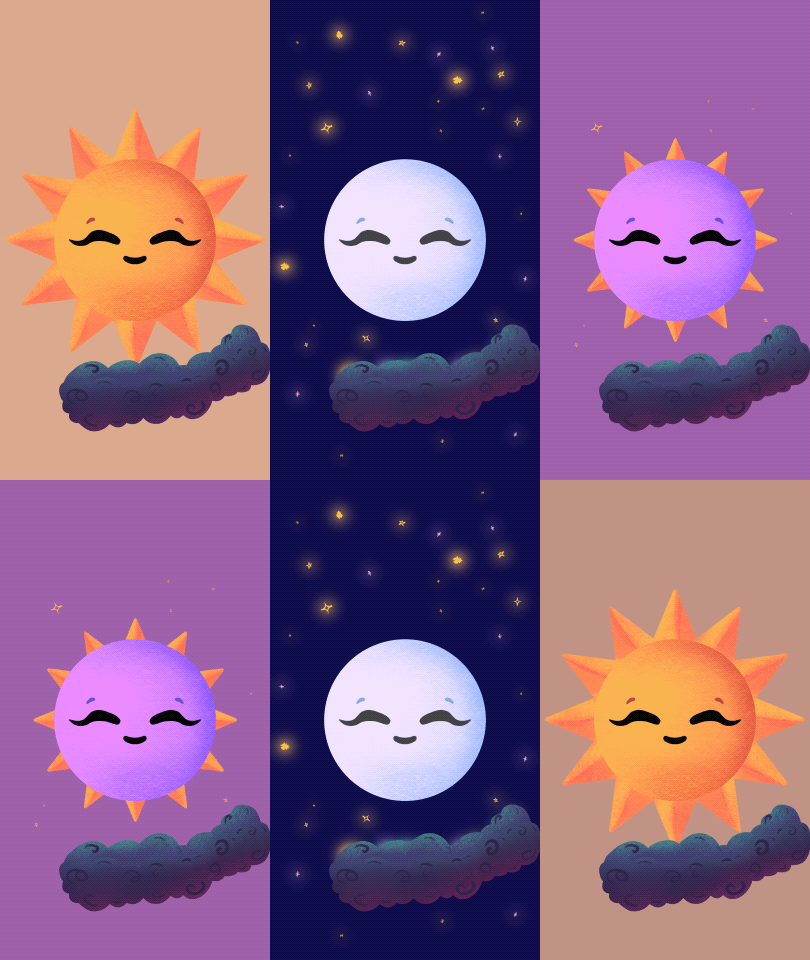
☯️ The Qualities of Yin and Yang
| Yang | Yin |
|---|---|
| Light | Darkness |
| Warmth | Cold |
| Activity | Rest |
| Strength | Weakness |
| Sunlight | Shadow |
| Outward and upward movement | Inward and downward movement |
| Daytime | Nighttime |
These qualities allow TCVM practitioners to classify everything — from body parts and functions, to food, herbs, and even acupuncture points.
🕒 Yin and Yang Throughout the Day
Even time follows this pattern.
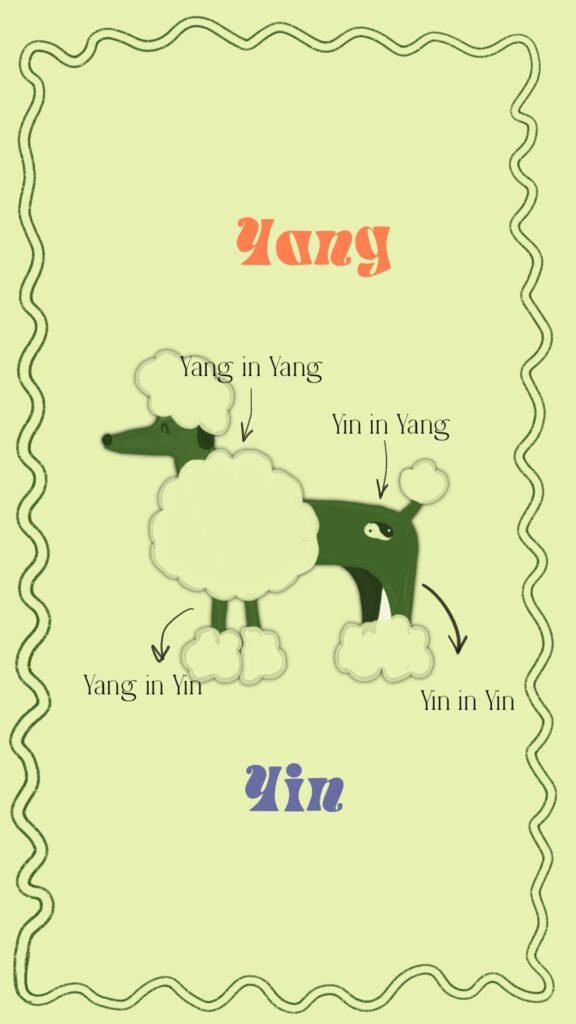
Morning = Yang within Yang (rising warm energy)
Afternoon = Yin within Yang (declining warmth)
Evening = Yin within Yin (cooling, stillness)
Late night = Yang within Yin (preparing for warmth)
This rhythm helps practitioners choose when to treat, what techniques to use, and even which herbs or acupuncture points are most effective at certain times of day.
🐶 Applying Yin and Yang to an Animal's Body
Let’s take a dog as an example. Depending on the location, function, and energy, each part of the body can be described as more Yin or more Yang.
The back is Yang → it’s exposed to light and heat
The belly is Yin → it’s shaded and softer
The front limbs are Yang → they move forward, engage
The rear limbs are Yin → they provide support and stability
The skin is Yang → outer protection
The internal organs are Yin → inward, functional essence
💢 What Happens When There’s Imbalance?
Health is the result of a dynamic balance between Yin and Yang.
If there’s too much Yang, an animal might become:
Hyperactive
Restless
Inflamed
Hot or panting excessively
If there’s too much Yin, the signs may include:
Weakness or lethargy
Cold limbs
Poor circulation
Digestive sluggishness
That’s why treatment must always consider which energy is dominant or deficient.
youtube.com/watch?v=l5ODwR6FPRQ
Simon´s Cat ©
🥢🌿 Treatment Based on Yin-Yang Theory
When there’s Excess, we must disperse.
When there’s Deficiency, we must tonify — meaning we nourish what’s lacking.
Acupuncture points and herbs have energetic properties that influence Yin and Yang, guiding the body back toward homeostasis.
This is why acupuncture isn’t just a physical treatment — it works through the energetic systems of the body. And that’s also why some people feel it “doesn’t work”: it requires an understanding of both the inner state and the energetic balance, not just the symptom.
🍵 Summary
There is no Yang without Yin.
There is no meaning for Cold without Heat.
There is no health without balance.
In Traditional Chinese Veterinary Medicine, understanding this balance allows us to see beyond symptoms and treat the root of the problem — guiding the body back to harmony.
- XIE, S. PREAST, V 2013. Traditional Chinese Veterinary Medicine. Fundamental Principles, 2nd Edition. Chi University, Florida, USA.
- Simon´s Cat video
